
Criminal Court Cases in Mills County
Iowa does not divide local criminal work among separate county felony and city municipal courts. The Iowa District Court, Fourth Judicial District, handles Mills County felony, aggravated misdemeanor, serious misdemeanor, and simple misdemeanor files. Judicially filed city ordinance and traffic matters also enter the unified state system. Research found no separate criminal court database for Glenwood, Malvern, or Emerson. That means a city name is not the right court filter. Select Mills County in the statewide search.
The Mills County Clerk of District Court keeps the official case file at 418 Sharp Street in Glenwood. Call 712-527-4880 for the counter’s current schedule, document availability, and copy charges. The clerk can address the complaint, trial information, docket, orders, judgment, sentence, and certified copies. The County Recorder is in the same courthouse, but that office handles land and vital records, not the Mills County criminal case file.
Mills County Criminal Clerk Counter
An online docket is an index and event summary. It may name a filing without offering the filed image to an anonymous user. The clerk is therefore the second stop when a Mills County court record needs proof beyond the screen. Have the exact case number ready. Ask whether the item is public, whether staff can send it electronically, and whether a plain or certified copy best fits the need. A public-access terminal is ordinarily available at Iowa clerk offices. No verified Mills County copy or certification fee appears in the research, so confirm the price before placing an order.
Mills County Clerk of District Court
418 Sharp Street
Glenwood, IA 51534
712-527-4880
Call before a visit to confirm the clerk counter’s hours and the current copy process.
The courthouse received documented accessibility upgrades in 2013. Other visit details, such as entry screening, device rules, and courtroom location, were not published in the sources reviewed. Ask the clerk about those points and about interpreter arrangements before travel.
Mills County Case Record Searches
Iowa Courts Online Search is the main free statewide index for a Mills County case search. An exact case number is the cleanest key. A party-name search can work when the number is unknown, but spelling and common names can produce several candidates. The court portal should be read as a docket, not as a fingerprint identity match.
- Open Iowa Courts Online and choose the trial-court case search path.
- Select Mills County to keep results tied to the local district court.
- Enter the exact case number when known. Otherwise, search by party surname and first name.
- Open the docket summary and review each count, event, status, judgment, sentence, and financial entry.
- Call the Mills County clerk with the case number to request a missing filing or certified court record.
| Search control | Type | Required | Notes |
|---|---|---|---|
| Case or Name Search | Mode | One mode | Choose the route that matches the identifier in hand. |
| Case Number | Text | Mode-dependent | Use the exact county and case sequence when known. |
| County | Dropdown | Optional | Select Mills to localize the results. |
| Party Last Name | Text | Mode-dependent | Spelling matters, and common names may return several people. |
| Party First Name | Text | Optional | Add it to narrow a name search. |
| Case Type | Filter | Optional | Criminal prefixes include FECR, AGCR, SRCR, and SMCR. |
The official Iowa Courts Online interface shows how statewide trial-court searching begins.
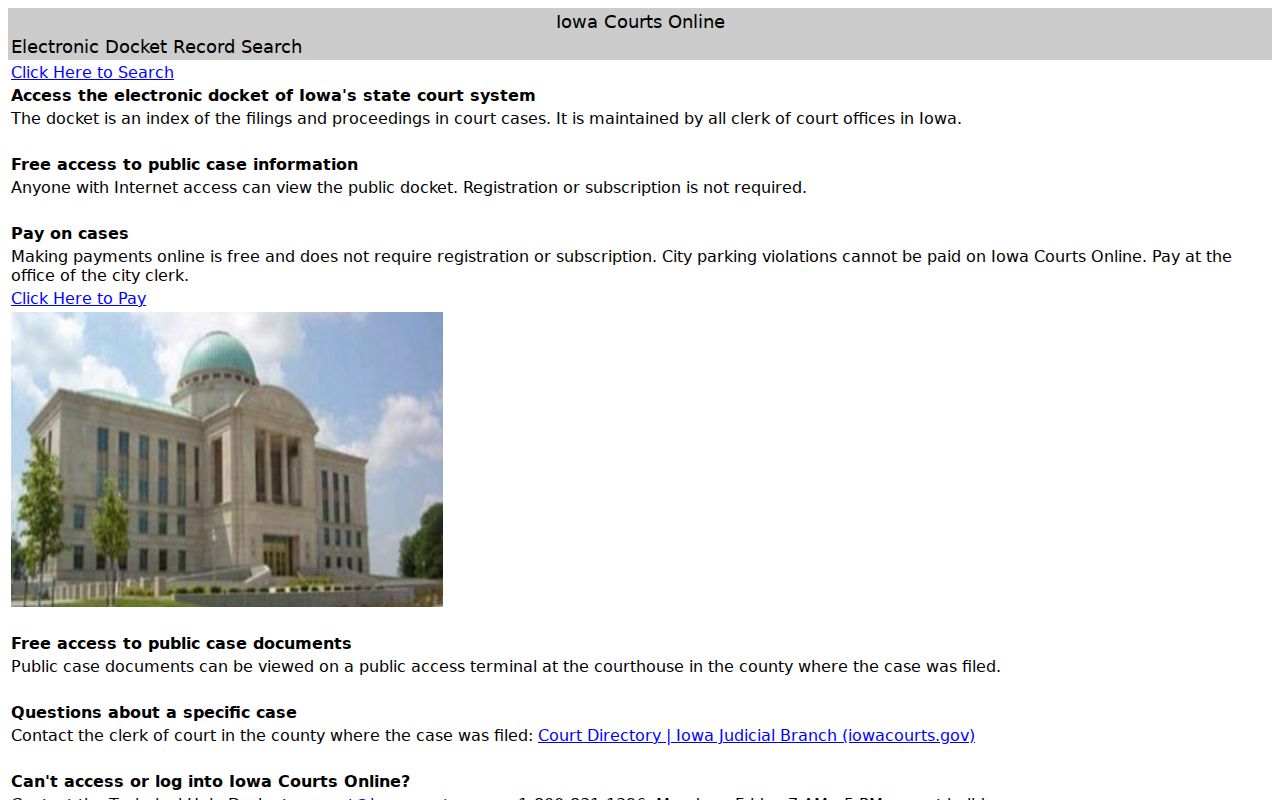
The screen is the starting point for a Mills County docket search, while the local clerk remains the source for filed documents and certified copies.
Mills County Criminal Case Prefixes
Four common prefixes help readers sort Mills County criminal court results. FECR generally marks a felony criminal case. AGCR points to an aggravated misdemeanor, SRCR to a serious misdemeanor, and SMCR to a simple misdemeanor. These labels are useful clues, but they are not the outcome. Charges can be amended, reduced, dismissed, or resolved differently by count. Always open the case and read the last relevant judgment.
- FECR
- A case prefix commonly linked to felony criminal matters in Iowa District Court.
- AGCR
- A prefix commonly linked to aggravated misdemeanor cases.
- SRCR
- A prefix commonly linked to serious misdemeanor cases.
- SMCR
- A prefix commonly linked to simple misdemeanor cases.
- Disposition
- The recorded outcome for a case or one charge within it.
A prefix also does not state the sentence. Iowa’s general penalty laws set class limits, but an offense-specific law can change the range. The final Mills County judgment controls what the court ordered in the case.
What a Criminal Case File Contains
A public Mills County criminal case file can join many facts that appeared at different stages. The caption identifies the parties. Charging papers state allegations. Docket events show what was filed and when. A judgment gives the result, and the sentencing order states the court’s terms. Financial entries can show fines, surcharges, costs, restitution, payments, and a balance. They should not be mistaken for the whole sentence.
| Case number and status | Identifies the Mills County file, prefix, filing date, and current docket status. |
|---|---|
| Charging document | Shows the complaint, trial information, or indictment and the allegations filed. |
| Counts and statutes | Lists charge descriptions, cited law, class, and later amendment or disposition by count. |
| Docket events | Tracks appearances, notices, motions, pleas, orders, warrant entries, and other filed actions. |
| Hearings | May give the hearing type, date, time, courtroom, or remote instructions. |
| Judgment and sentence | States the final result and terms imposed after a plea or verdict. |
| Financial ledger | May list court debt, payments, restitution, and remaining balance. |
Names and a similar charge are not enough to confirm identity. Match the case number, filing context, counsel, dates, and other public details. For the custody event that preceded a case, the separate Mills County arrest search explains the jail and agency record chain.
Mills County Charge Filing Role
The Mills County Attorney prosecutes state crimes and county ordinance violations. That office can file a trial information for an indictable offense, while a grand jury indictment is another formal charging route. The prosecutor’s charge may differ from the booking allegation, and the final result may differ from both. Compare the charging paper with the judgment instead of treating the earliest label as permanent.
The official Mills County Attorney page identifies the prosecutor’s local role and contact channel.

The office participates in the charge process, but it is not the public court-record custodian. Ask the Clerk of District Court for filed papers.
Criminal Case Stages in Mills County
A Mills County criminal case may start with a citation, complaint, or custodial arrest. An initial appearance can address identity, rights, counsel, and release. For an indictable offense, the prosecutor may file a trial information or a grand jury may return an indictment. Arraignment follows, and written arraignments are common in Iowa. Discovery, motions, plea talks, or trial then lead toward an outcome.
Case flow: Charges Filed › Arraignment › Pretrial › Plea or Trial › Disposition › Sentencing
Not every case uses every event, and not every count moves in the same way. After judgment, the docket may continue with posttrial motions, an appeal, payment activity, or supervision entries. A deferred judgment is also distinct from a dismissal. Successful discharge is a nonconviction path, but court expungement and Iowa DCI disclosure rules still require separate review.
Missing Mills County Court Documents
A docket can list a complaint, order, plea, or sentencing event even when no public download appears. That does not mean the document never existed. Iowa Courts Online provides an index and summary, and access to document images is not uniform for anonymous users. Older papers can also require staff retrieval.
Write down the full Mills County case number and the exact docket entry date or title. Then call the clerk. Ask whether the paper is public, whether it is stored electronically, and what copy charge applies. For a judgment that must carry formal court authentication, request a certified copy rather than a screen print. The research does not establish a current fee, so avoid assuming the service is free.
Note: A docket entry confirms a filed event, but only the underlying order supplies its full terms and context.
Access Rules for Case Records
Public access does not make every Mills County court item open without redaction. Juvenile court records are generally confidential under Iowa law. Sealed or expunged cases, protected identifiers, victim details, and information about minors can also be absent or masked. A sealed or confidential file should not appear in an ordinary public search merely because it once had a case number.
Iowa Code chapter 232 governs juvenile confidentiality and sealing. Iowa Code chapter 901C governs qualifying expungement. Court access follows Judicial Branch rules, so a records question for the clerk is not handled like a standard county-department request under chapter 22.
When a Mills County case does not appear, verify spelling, county, and case type first. Then contact the clerk. A missing result can reflect a search problem, delayed entry, confidentiality, sealing, expungement, or the fact that no charge was filed. It should not be turned into a claim about guilt or innocence.
Mills County Felony Case Limits
Iowa class labels provide legal boundaries, not a prediction of the sentence in a Mills County case. A Class A felony generally carries life imprisonment. General maximum terms are up to 25 years for Class B, 10 years for Class C, and 5 years for Class D, unless a specific statute supplies another rule. Enhancements and mandatory provisions can alter those general limits.
The official Iowa felony sentencing chapter provides the statewide statutory framework.
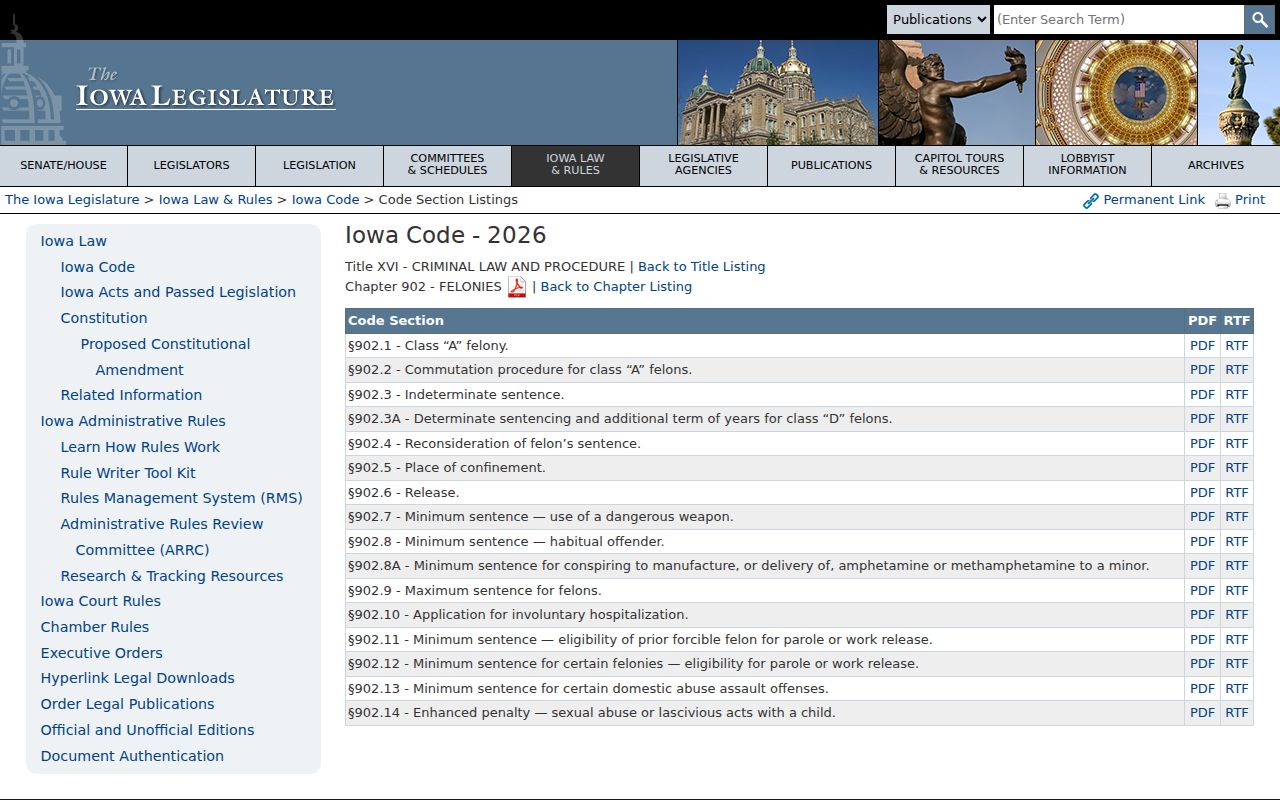
The statute helps decode a charge class, but the Mills County judgment remains the source for the actual conviction and sentence.