
Glenwood Criminal History Checks
Begin by deciding which Glenwood record answers the question. Glenwood Police keeps the Glenwood report it creates. The Mills County Jail keeps Glenwood intake and custody facts. The Clerk of District Court keeps the filed Glenwood charge, docket events, judgment, and sentence. Iowa DCI maintains a separate statewide criminal-history product. One Glenwood search cannot replace the other three.
- Ask Glenwood Police for the incident or arrest report, using the incident date, location, and report number when known.
- Call Mills County Jail when recent custody or booking status is the main question.
- Search Iowa Courts Online with Mills County selected to find a filed case and its outcome.
- Call the Mills County Clerk with the case number when a public filing or certified copy is needed.
- Order the official Iowa DCI name and date-of-birth check when the statewide repository record is needed.
The broader Mills County criminal-history overview explains the county and state layers in more depth. For a Glenwood event, keep the city report tied to its matching jail and court identifiers.
Glenwood Police Record Custodians
Glenwood is the county seat and the only one of Mills County’s three largest cities with its own police department. The city’s open-records policy names the police chief as lawful custodian for police records. That makes Glenwood Police the first stop for a report created by a city officer, even though an arrest may lead to county booking and a state court case.
The official Glenwood Police page shows the department and its city setting.
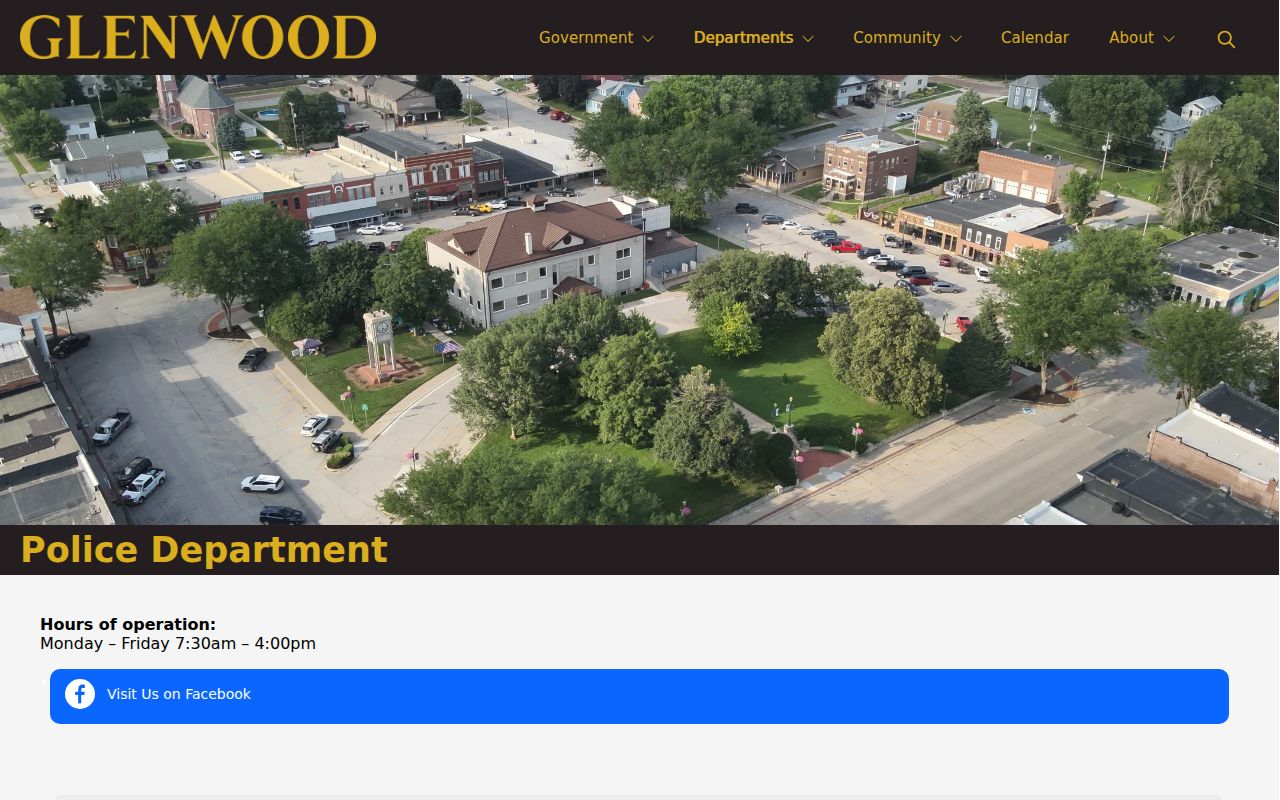
The image reinforces why a Glenwood police report remains a city-held record even after other offices create related files.
Glenwood Police may hold a Glenwood incident report, arrest report, and related investigation material. The Mills County Jail does not become custodian of those Glenwood records merely because it accepted a person for booking. Likewise, the Clerk of District Court cannot provide the Glenwood officer’s full narrative when its file contains only the complaint, trial information, orders, and judgment. Ask Glenwood Police which basic facts or releasable portions can be provided if the full Glenwood investigation record is confidential.
No verified Glenwood police app, daily blotter, crime map, or separate report portal was found. The city’s lawful-custodian route is the official fallback. A written Glenwood request should give enough detail to locate the file without sweeping in unrelated events. Include contact details, incident date and place, report number when known, desired format, and delivery choice. Let the custodian state any review or redaction cost before production.
Records at Glenwood Police Department
The city policy lists the Police Chief at 3 N. Vine Street, Glenwood, IA 51534, and 712-527-9920. The current general city page instead lists 5 N. Vine Street and 712-527-4717. Both are official references. Call before visiting or mailing a request so staff can confirm the right address, current counter, and applicable police-record procedure.
A useful Glenwood request identifies the record, incident date, place, and incident number, then states the desired format and delivery method. Glenwood’s general policy says some Glenwood police investigation records follow a separate policy. Ask what part is releasable, what must be redacted, and what actual cost applies. The Glenwood policy does not create an unrestricted right to an active investigation file.
Glenwood Police Custodian
3 N. Vine Street
Glenwood, IA 51534
712-527-9920
Call first because official city pages list two addresses.
Glenwood Record Address Check
The 3 N. Vine and 5 N. Vine references do not mean two police agencies hold the same Glenwood record. They reflect two official Glenwood contact listings. A requester should not guess which door or mailing line is current. Phone the police custodian, describe the requested Glenwood report, and confirm where it should go before sending payment or personal details.
The Glenwood open-records policy displays the city’s custodian routing and reasonable-cost principles.
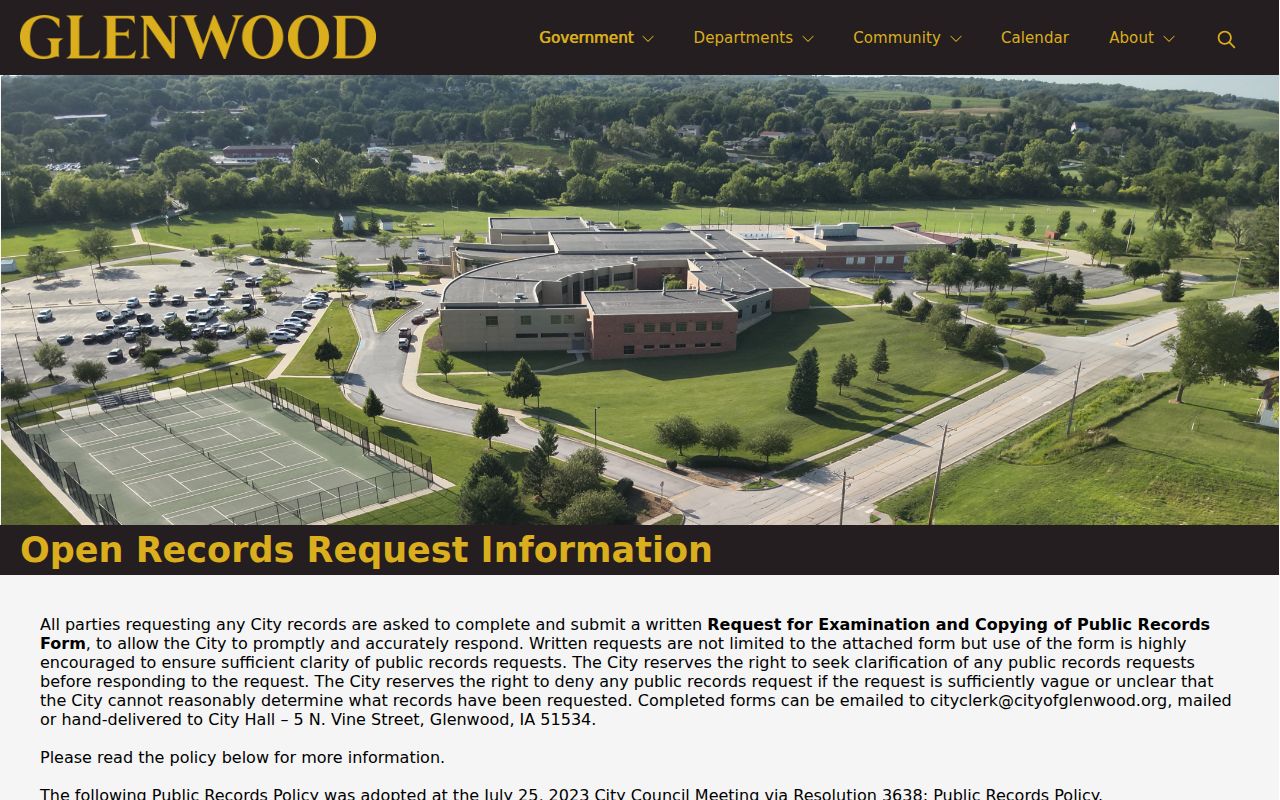
That routing table matters because the police custodian, not a general city desk, decides how a Glenwood investigation request is handled.
Booking and Arrest Records in Glenwood
Glenwood has no publicly identified city jail. When Glenwood Police makes a custodial arrest, the person is taken to the Mills County Jail at 600 Industrial Road. The police arrest report and the jail booking file are separate. One describes the officer’s action and alleged offense. The other records intake, custody, charge and bond information, classification, property, fingerprints, and release events.
No verified online Mills County booking roster exists. For recent Glenwood custody, call the jail at 712-527-4275. If staff cannot release the desired detail by phone, ask the sheriff’s records clerk about a narrow Glenwood booking request under Iowa chapter 22. A filed Glenwood court case may appear later, so a same-day Iowa Courts Online search can be too early. An arrest is not proof of guilt.
Glenwood Reports Versus Bookings
The easiest Glenwood record mistake is treating the police report and booking as duplicates. They serve different offices and moments. The comparison below helps a reader send a request to the custodian that created the facts.
| Glenwood record | Custodian | What it answers |
|---|---|---|
| Incident or arrest report | Glenwood Police | Officer narrative, event details, and alleged offense |
| Booking or custody file | Mills County Sheriff/Jail | Intake, holding status, bond, and release events |
| Criminal docket | Mills County Clerk | Filed counts, orders, plea, disposition, and sentence |
| Iowa history | Iowa DCI | Releasable statewide repository data |
Match Glenwood names, dates, and case or booking numbers before drawing a conclusion. Each Glenwood record can update on a different schedule.
The Glenwood Municipal Court File
Glenwood does not have a separate municipal court portal. Iowa uses a unified District Court, so criminal and judicially filed city matters appear through Iowa Courts Online under Mills County. Do not waste time searching for a “Glenwood Municipal Court” choice. Use the Mills filter and an exact case number when possible.
| Court Name | Iowa District Court, Fourth Judicial District, Mills County |
|---|---|
| Case Types Heard | Felony, aggravated, serious and simple misdemeanor cases, plus judicially filed city matters |
| Case Lookup Channel | Iowa Courts Online, then the Mills County Clerk counter |
| What the Docket Shows | Charges, filings, counsel, status, orders, judgment, sentence and financial entries |
| Copies & Fees | Ask the clerk whether the file is public and what plain or certified copy charge applies |
The clerk is at 418 Sharp Street in Glenwood and can be reached at 712-527-4880. Call before travel for current counter hours.
Glenwood Court Record Split
Being the county seat places Glenwood’s police and courthouse close together, but it does not merge their files. A city report can exist without an arrest. A booking can occur before prosecutors file a case. The court docket begins when a charge is filed and may later show dismissal, amendment, acquittal, conviction, or deferred judgment.
In Iowa Courts Online, FECR commonly points to felony criminal cases, AGCR to aggravated misdemeanors, SRCR to serious misdemeanors, and SMCR to simple misdemeanors. Treat the prefix as a search clue, then read each count and final outcome. Anonymous users may see an index without every document image. Call the clerk with the number for the complaint, trial information, judgment, or sentence.
How Glenwood Records Reach the County
A Glenwood officer creates the city report. If custody follows, Mills County Jail creates the booking. The Mills County Attorney may file the accusation in Iowa District Court, and the clerk records the court events and result. Arrest fingerprints and reportable outcomes can then reach Iowa DCI. Delays or a mismatch can leave one layer ahead of another.
Record flow: Glenwood Police › Mills County Jail and Courts › Iowa Department of Public Safety, Iowa Division of Criminal Investigation
For fresh Glenwood activity, start with police and jail. For a filed outcome, use the court docket. The DCI product is the official Iowa repository check, but it is name and exact date-of-birth based and can release a narrower set than a public docket.
Correcting a Glenwood Record
When your own Glenwood history looks wrong, identify the layer that contains the error. Ask Glenwood Police about its event report, the Mills County Clerk about the filed disposition, and DCI about the state entry. DCI depends on fingerprints and reports from agencies and courts, so the local source document may be needed to resolve a state mismatch.
Iowa Code §692.5 gives a person access and challenge rights for criminal-history data. DCI may review the supporting fingerprint record or request new prints. A “no Iowa criminal history found” response does not prove no Glenwood event exists. It can also reflect confidential or nonreleasable information. Verify the court outcome and originating report rather than relying on one phrase.
Glenwood Record Access Rules
Glenwood police files, court dockets, and DCI histories have different access rules. Iowa’s open-records law supports inspection and reasonable copy terms but permits confidential categories and redaction. Police investigative material can be withheld while basic incident facts may be available. Juvenile, sealed, expunged, victim, and protected identifying information do not belong in an ordinary public release.
Key Statutes:
Iowa Code chapter 22 sets public examination rights, reasonable costs, and confidential exceptions.
Iowa Code chapter 692 governs DCI dissemination and a subject’s challenge rights.
Iowa Code chapter 232 restricts and provides sealing rules for juvenile court records.
Describe the Glenwood record narrowly and ask the named custodian for the releasable portion. A redacted report is not the same product as a court docket.
Glenwood Record Context
Glenwood counted 5,073 residents in the 2020 Census and had a July 2025 estimate of 5,287. It covers 2.92 square miles and serves as Mills County’s seat. Those facts help explain the city’s unusual local split: its own police custodian handles city reports while the county jail and district clerk sit in Glenwood and create the next records.
The town was known as Coonsville before its 1853 name change. Its courthouse square became the center of local recordkeeping, though the current courthouse dates to 1959 and gained accessibility and office improvements in 2013. This history does not change access law, but it explains why a Glenwood search may involve city and county counters only blocks apart.
That close setting can still cause a routing error. The Recorder handles land and vital records, not the Glenwood criminal docket. The County Attorney prosecutes state crimes and county ordinance violations, but it is not a public record clearinghouse. An unrepresented defendant must obtain written court approval before contacting that office about a case. For a court record, use the Clerk of District Court. For a Glenwood police narrative, use the city’s police custodian.
Recent Glenwood events can also show why the routing chain matters. An August 2025 neighborhood shooting and fire brought Iowa DCI into a Glenwood investigation. Without using private names, the event shows how a Glenwood response can involve city police, a state investigative agency, county custody, and later court records. A Glenwood police request should still seek the city-created material, while a DCI release follows state rules. If a case was filed, the Mills County docket supplies the judicial history. The agencies worked on one event, but they did not create one merged Glenwood record.
Fees also depend on the custodian. Glenwood’s policy uses reasonable and actual-cost principles, yet the research did not locate a fixed Glenwood police report price. Ask for an estimate before work starts. The sheriff likewise publishes no set copy fee for a related jail file. The clerk should confirm its current plain or certified copy cost. This approach keeps each Glenwood request tied to a verified charge instead of assuming the whole chain is free.
Note: Population figures provide context, not a measure of crime or the chance that a named person has a record.