
Mills County Criminal History Checks
Start with the kind of fact you need. A filed charge, judgment, sentence, or court debt belongs to the Mills County Clerk of District Court. A sheriff incident report, recent booking, jail status, or county warrant question belongs to the Mills County Sheriff. Glenwood Police is the custodian for reports its officers created. The Iowa Division of Criminal Investigation, or DCI, provides the state repository check. Each source describes a different slice of Mills County criminal history.
The Mills County government directory is a useful first routing point. Its layout also shows why the office name matters when a request is made.
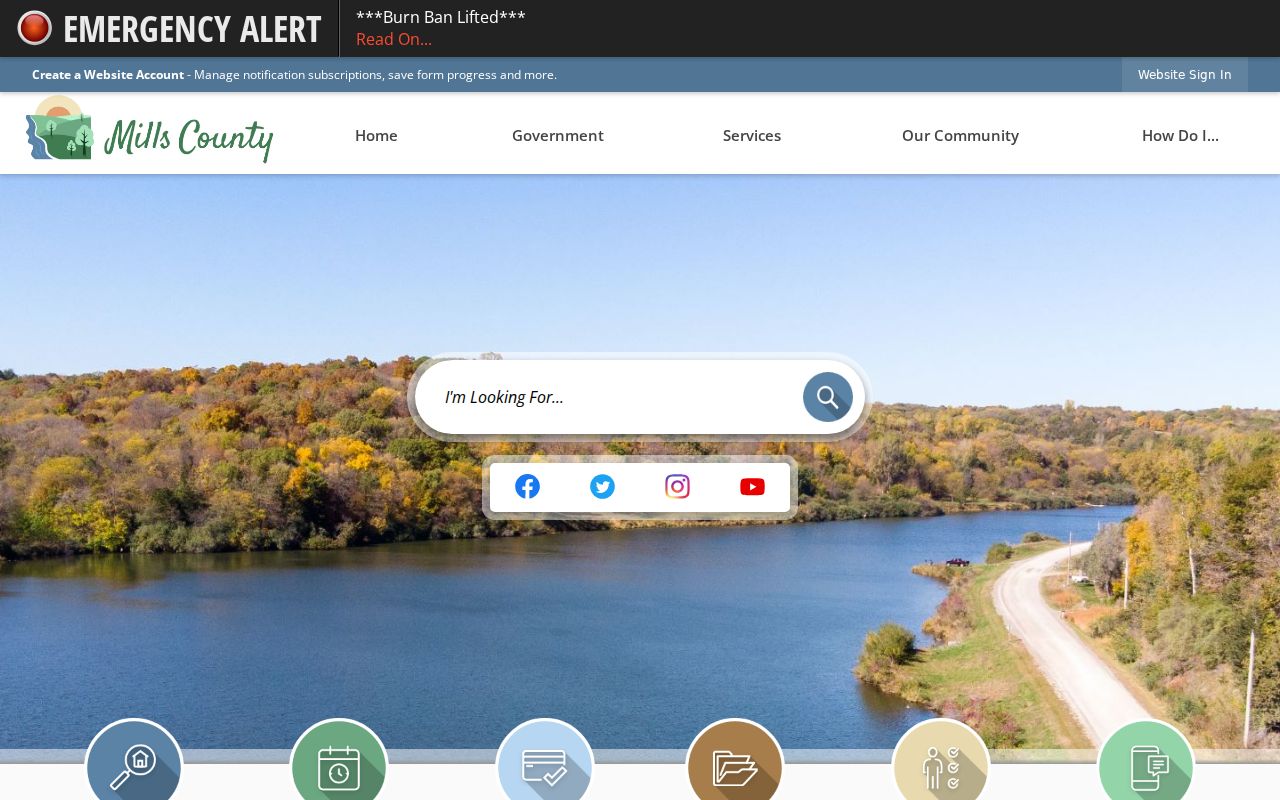
Use the department that possesses the source record, then move to another layer only when the first record cannot answer the question.
- Search Iowa Courts Online for a filed Mills County case by exact case number or party name.
- Call the clerk when a docket entry has no public document image or when a certified copy is needed.
- Contact the jail for current custody and the arresting agency for its incident or arrest report.
- Order the DCI name-based check when the goal is a releasable Iowa repository history.
- Verify a disputed entry with both the office that created it and the office that now displays it.
Mills County Record Custodians
Four main custodians divide the work. The Clerk of District Court at 418 Sharp Street keeps the district docket and filed papers. The Sheriff and Mills County Jail at 600 Industrial Road hold sheriff reports and booking material. Glenwood Police keeps city-generated investigation records. DCI compiles fingerprint-supported Iowa arrest cycles and reported dispositions, but its public name check has release limits.
Mills County does not publish one universal criminal-record request portal. Its Public Information page directs each request to the department that has the record. The Auditor at 712-527-3146 can help route an uncertain request, but that office does not decide access to a sheriff file.
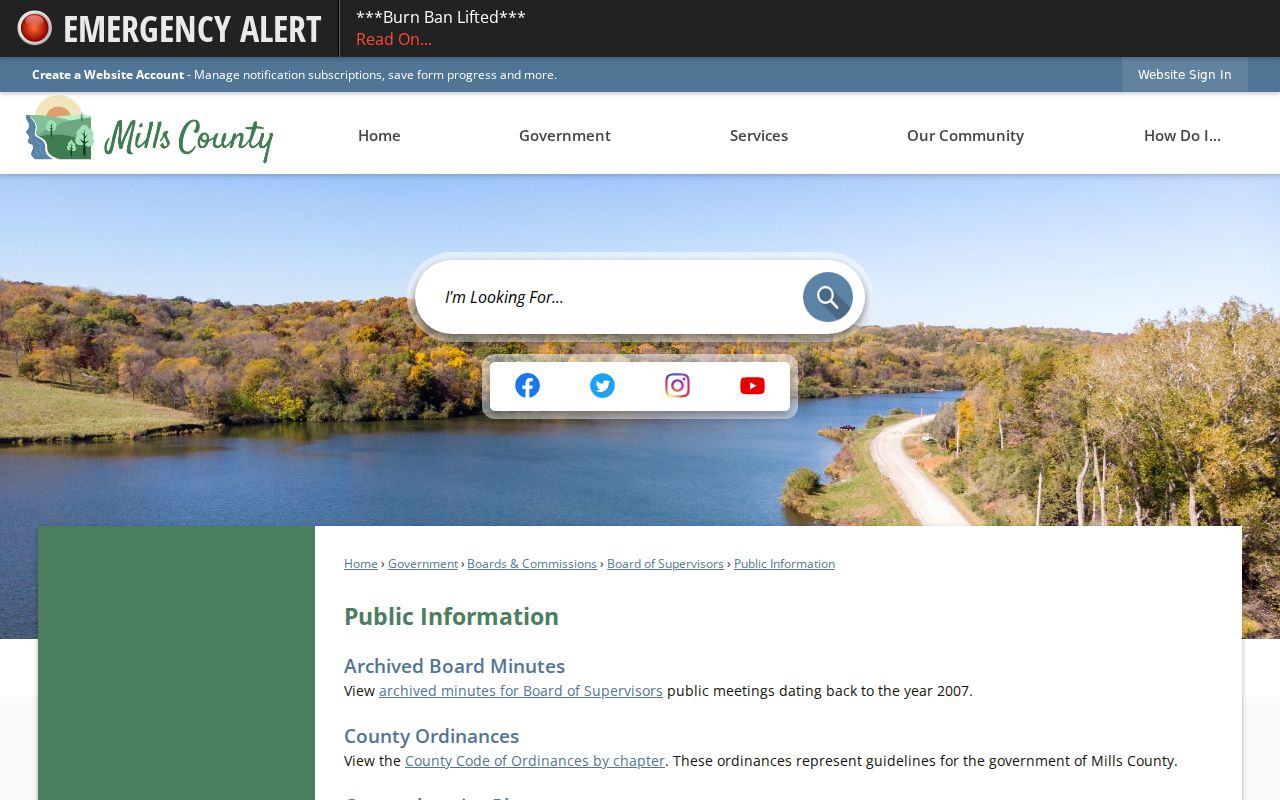
This department-by-department rule prevents a court-file request from being sent to the jail or a Glenwood police report request from being sent to the clerk.
Mills County Clerk
418 Sharp Street
Glenwood, IA 51534
712-527-4880
Monday-Friday, 8:00 a.m.-4:30 p.m.
Sheriff Records
600 Industrial Road
Glenwood, IA 51534
712-527-4871
Monday-Friday, 7:30 a.m.-4:00 p.m.
Mills County Jail
600 Industrial Road
Glenwood, IA 51534
712-527-4275
Call for public custody details.
Official Background Checks in Iowa
The Iowa Department of Public Safety, Iowa Division of Criminal Investigation, maintains the state repository. Its Iowa Record Check Online information explains online, mail, fax, email, and in-person request options. The public product is name and exact-date-of-birth based. It costs $15 for each last name searched, so a maiden name or other surname needs a separate paid request.
The form requires the subject's first and last name, exact birth date, requestor details, return method, and billing information. Middle name, gender, and Social Security number can help distinguish identities but are not minimum search fields. A signed release is not required. Without one, however, DCI withholds completed deferred judgments and arrests more than 18 months old when no final disposition is reported. For a Mills County reader, the result covers Iowa DCI files, not every state or the FBI.
| Product | Scope | Cost | Identity Method |
|---|---|---|---|
| DCI Iowa check | Releasable Iowa repository data | $15 per last name | Name and exact date of birth |
| FBI Identity History Summary | Subject's federal identity history | Current portal fee | Fingerprints |
| Iowa Courts Online | Public court docket data | Basic search is free | Name or case number |
Mills County DCI Search Limits
A DCI response and a Mills County court search are not substitutes. DCI warns that a name and birth-date match cannot supply fingerprint-level identification. A response stating that no Iowa criminal history was found can also reflect nonreleasable material or confidential juvenile information. It does not prove that no police contact, booking, or court event ever existed.
The DCI record-check page shows the request routes and forms that must be completed.
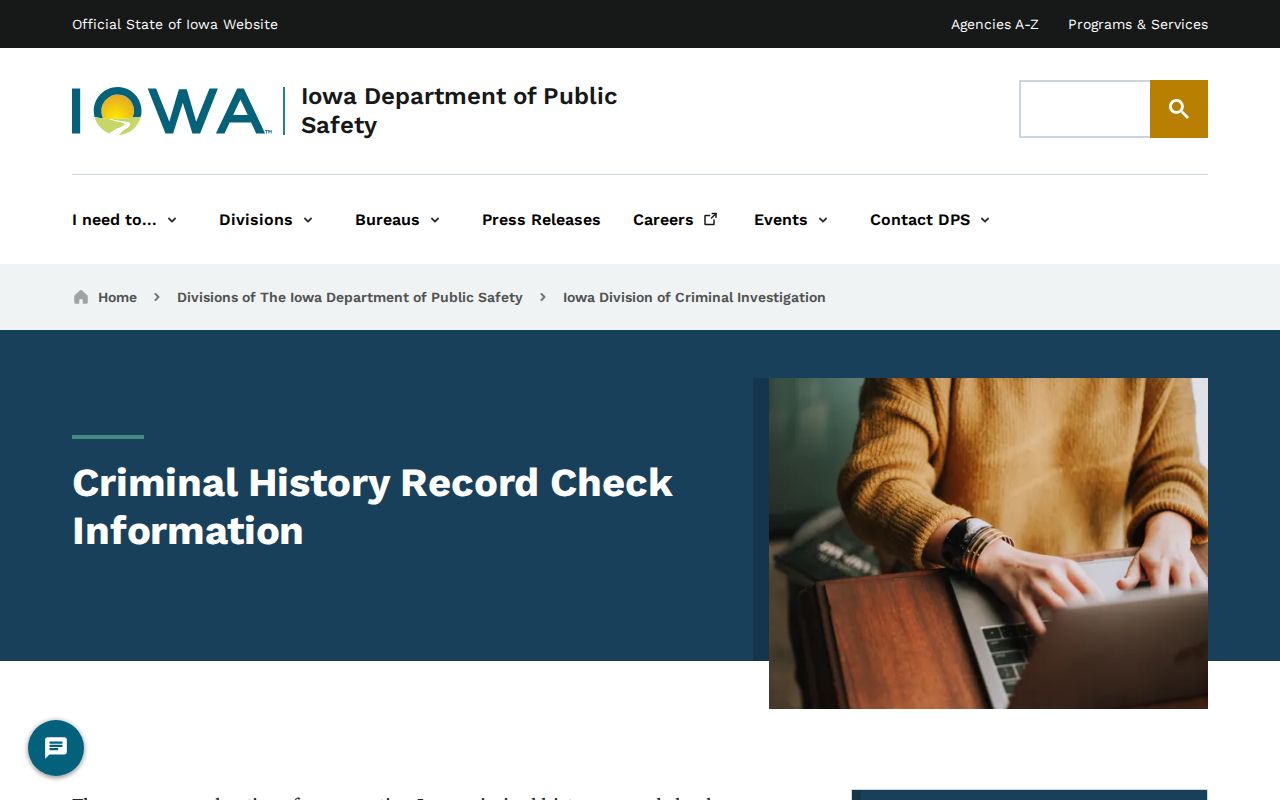
Submit both the request and billing parts. DCI accepts no telephone requests, though staff can answer process questions at 515-725-6066.
Someone correcting their own record should first compare the DCI entry with the Mills County judgment and the originating arrest report. Iowa Code section 692.5 provides access and challenge rights. DCI reviews the fingerprint record behind a disputed item and may ask for new prints. Mills County does not publish civilian fingerprint-card hours or fees, so call the sheriff before going to the office.
Kinds of Criminal Records
Mills County criminal records develop in stages. An incident report records what an officer investigated. An arrest file records the legal basis, time, place, alleged offenses, and officer action. The jail creates a booking record after intake. If prosecutors file a case, the clerk creates a court docket. DCI later compiles reported arrest and disposition data at the state level.
These records can disagree in timing without being false. A same-day booking may appear before a case is filed. The prosecutor can amend the initial charge. A court may dismiss one count while another ends in a conviction. A state repository update can trail the clerk's entry.
- Booking record
- The custody and intake snapshot made by Mills County Jail.
- Court case file
- The clerk-held docket, filings, orders, judgment, sentence, and financial entries.
- DCI history
- The fingerprint-supported Iowa compilation of arrest events and reported outcomes.
- Warrant record
- Court-issued process tracked by the clerk and the agency responsible for service.
Mills County Jail Record Fallback
No verified public web roster exists for Mills County Jail. Current custody questions therefore begin by calling 712-527-4275. Ask for public information such as whether the person is presently held, the booking reference if releasable, public charge or bond details, and the expected court route. Staff may limit what they give by phone.
The official sheriff history says people arrested by county deputies, Glenwood Police, or Iowa State Patrol all enter the county jail. That makes the jail a useful cross-agency custody checkpoint. It does not make the sheriff the custodian of every underlying report. A Glenwood Police arrest report stays with the city even when the jail holds the person. Court filings remain with the clerk.
No online roster: Call the jail, check Iowa Courts Online for a filed case, and request the originating agency's report under Iowa chapter 22.
For a person transferred to an Iowa prison or placed under state supervision, use Iowa Offender Search. Federal custody uses the Bureau of Prisons locator. Neither system replaces a call about present Mills County Jail custody.
Mills County Criminal Records: What They Contain
A careful Mills County criminal history review reads each field in context. Names and birth dates help with matching, but the case number is the best link to a court file. Charge text describes an allegation until the docket records an outcome. The judgment and sentence show what the court finally ordered. A custody status shows where a person is held or supervised, not the full path of the case.
| Name and identifiers | Spelling, aliases, birth details, and agency identifiers used to distinguish records. |
|---|---|
| Arrest and booking | Agency, date, place, alleged charge, intake, bond, and release events. |
| Filed charges | Complaint or trial information, statute, offense class, and later amendments. |
| Disposition | Dismissal, acquittal, conviction, deferred judgment, or another count-specific result. |
| Sentence | Confinement, probation, fines, restitution, and other court orders. |
| Supervision | Public jail, prison, probation, or parole status within statutory limits. |
Always read counts one by one. Iowa case prefixes such as FECR, AGCR, SRCR, and SMCR point toward common case classes, but the final filed charge and judgment control.
Mills County Booking Versus Conviction
A booking proves that Mills County Jail processed a person. It does not prove guilt. The booking can include a photo, fingerprints, property inventory, classification, the transmitted charge, and release or bond events. Those facts belong to the custody stage.
A conviction appears only after a guilty plea or verdict and a judgment. The first arrest label can differ from the charge the County Attorney files. It may also differ from the count that survives plea talks or trial. For the case outcome, search the Mills County docket and obtain the judgment from the clerk. The full Mills County court case lookup explains how to read filed counts and docket events without treating an accusation as the result.
| Record | What it proves | Best source |
|---|---|---|
| Arrest report | An agency documented an arrest or citation | Originating police or sheriff |
| Jail booking | Custody intake occurred | Mills County Jail |
| Court judgment | The court entered the final result | Clerk of District Court |
Note: A dismissal ends the court charge without a conviction, but the original arrest and booking records may still exist unless law restricts them.
Iowa Public Access Laws
Iowa law separates access to agency records, court files, state histories, juvenile matters, and registry information. Mills County routes open-record requests to the department holding the item. The clerk follows Judicial Branch access rules for court files rather than acting as an ordinary county department.
Key Iowa laws:
Iowa Code chapter 22 grants examination rights, permits actual costs, and protects listed confidential records.
Iowa Code chapter 692 governs DCI dissemination plus a subject's access and challenge rights.
Iowa Code chapter 232 makes most juvenile court material confidential and provides sealing rules.
Iowa Code chapter 901C provides expungement routes for eligible Iowa cases.
Peace-officer investigative material may be confidential even when basic incident facts can be released. Protected identifiers, victim and minor information, and confidential investigative details may be withheld or redacted. Ask the custodian what portion is public and whether review or redaction costs must be paid first.
Mills County Warrant Confirmation
Mills County does not publish a verified public warrant list. Iowa Courts Online can show a warrant-related docket entry, but it is not a complete real-time warrant database. Someone trying to resolve their own possible warrant should confirm it through official channels and avoid acting on an old screenshot.
- Call the Mills County Sheriff at 712-527-4871 for the law-enforcement confirmation route.
- Call the clerk at 712-527-4880 for public case entries, the issuing court, and case number.
- Ask about bond, appearance, or surrender directions from the proper office.
- Follow court or counsel instructions and obtain proof when the matter is cleared.
An arrest warrant authorizes custody. A bench warrant often follows failure to appear or comply. Search warrants and juvenile or unexecuted investigative process may be sealed. System updates can take time after payment or appearance, so written court confirmation is more reliable than an unofficial search result.
Restricted, Sealed & Expunged Records
Iowa expungement generally makes a qualifying record confidential. It does not mean every trace in every system is physically destroyed at once. Juvenile court material is usually confidential under chapter 232. Completed deferred judgments follow their own rules, and DCI explains that a discharged event can remain in its file while release is restricted.
Chapter 901C covers eligible dismissals and acquittals plus a narrow, once-in-a-lifetime misdemeanor conviction route. That conviction path has a waiting period, payment and pending-charge conditions, and a long list of excluded offenses. A person should use the current Iowa Judicial Branch criminal expungement form and file in the existing Mills County case. The research did not verify a local filing fee, so ask the clerk rather than assuming the filing is free.
After an order, recheck Iowa Courts Online and order your own DCI history after allowing update time. If a disposition remains wrong, compare the order with the DCI entry and use the section 692.5 challenge process.
Mills County Supervision Records
Mills County probation and parole services use a state district structure. The Iowa Department of Corrections Fourth Judicial District serves Mills and nine other southwest Iowa counties from Council Bluffs. Iowa Offender Search can show public information about state incarceration, probation, or parole that a county jail call cannot.
The Fourth Judicial District correctional services page identifies the district and its local supervision programs.
The district office is at 801 S. 10th Street in Council Bluffs and can be reached at 712-325-4943. Public fields under Iowa Code section 904.602 can include status, offense, county of commitment, duration, and a location other than a home street address. A court docket shows that probation was ordered. The Iowa Board of Parole and IDOC records show parole or prison status. Confidential plans, treatment details, and home addresses do not become public merely because supervision exists.
City-by-City Criminal Records in Mills County
Glenwood, Malvern, and Emerson are Mills County's three largest incorporated cities in the 2020 Census place counts. Their record routes differ. Glenwood has its own police department and lawful custodian. Malvern uses the Mills County Sheriff under a chapter 28E agreement. Verified Emerson criminal-record channels also begin with the sheriff. All three use the county jail and Iowa's unified District Court rather than separate municipal criminal-court portals.
Glenwood Record Check
5,073 in 2020. Police reports stay with Glenwood Police; bookings and court files move to county offices.
Malvern Record Check
1,046 in 2020. Sheriff services operate through Malvern's chapter 28E agreement.
Emerson Record Check
368 in 2020. Use the sheriff, jail, clerk, and DCI chain instead of a nonexistent city portal.
The Census profile for Mills County supplies broader population context for these local service routes.
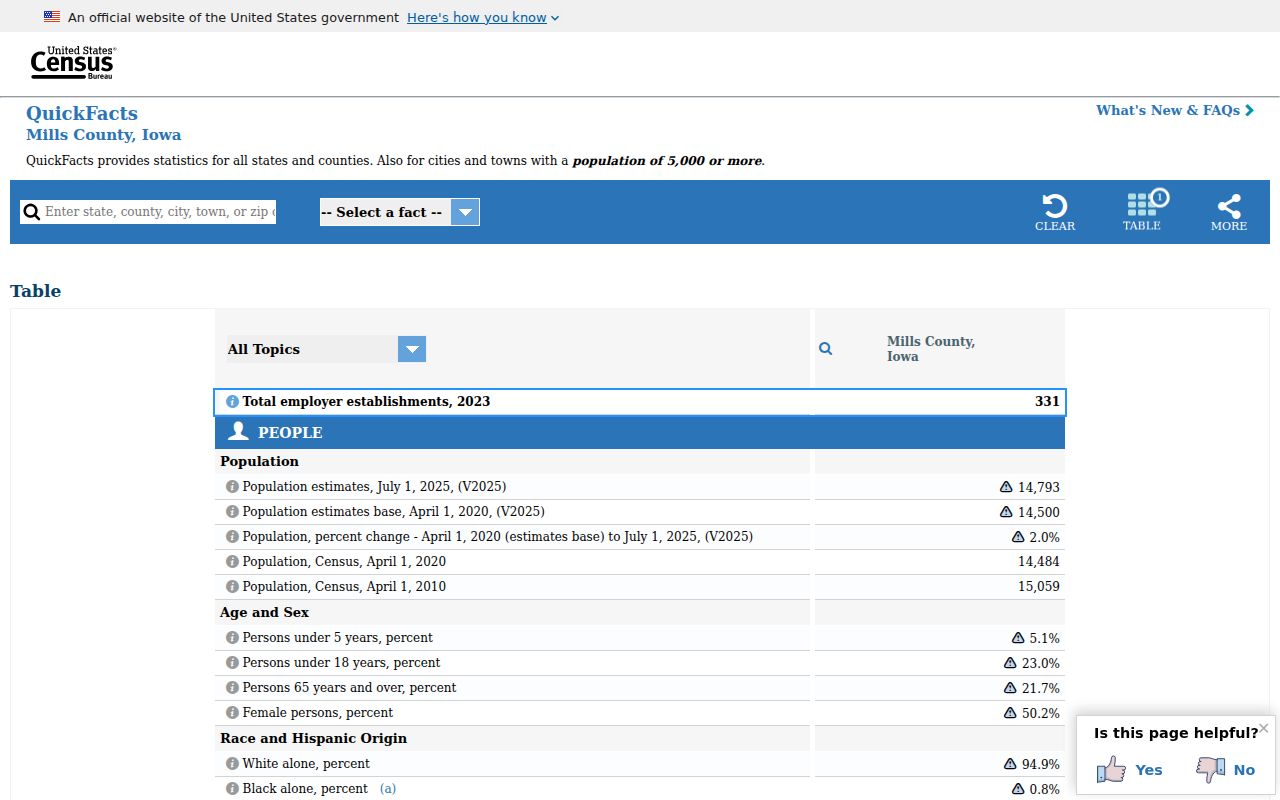
Mills County population size does not change the legal meaning of a record. It does explain why some services remain countywide while Glenwood maintains a separate police-record channel.
Mills County Record System Layers
A local, state, and federal check answers three different questions. Mills County offices hold local reports, bookings, and district court files. DCI supplies the releasable Iowa repository history. Federal cases for Mills County belong to the U.S. District Court for the Southern District of Iowa and are searched through PACER. Federal custody belongs in the Bureau of Prisons locator.
Use the narrowest official source first. The clerk is best for the exact outcome of a Mills County charge. The sheriff or Glenwood Police is best for the agency narrative. DCI is best for the official Iowa product, subject to its scope and release rules. An FBI Identity History Summary is a subject-only fingerprint process and is not a public name search of someone else.
This layered approach also helps spot errors. When the arresting agency, court judgment, and DCI result do not align, compare dates and case numbers before seeking a correction. Reporting lag is possible. So are name-match limits. The originating office remains the best source for the fact it created.